
BlockThreat - Week 36, 2026
$329M stolen across 14 incidents. Silent patches. Four chains hacked.

Five days. That was the time between a quiet fix published in the public Elements repository and attackers draining 4000 BTC from the Liquid federation wallet. The commit c26d719 titled fix: range proof cache bind to asset and scriptpubkey was merged into master on September 1st, but never made it into an official release. No coordinated disclosure, mass patching or alarm bells going off until the disaster struck. It only took attackers five days to weaponize and execute the hack.
If that sounds familiar, it really should. Just last week, we discussed the very same failure mode in the Cosmos mass compromise incident. A bug deemed not urgent, a quiet fix, reverse engineered patch followed by a weaponized exploit, and then six networks were hit for $12M. The Liquid incident is just another reminder that there is no such thing as a silent patch. Attackers diff open and closed source releases all the time to figure out exactly what is being fixed and why.
What makes 2026 so much worse for this attack path is the sheer speed with which a vulnerability or a published patch becomes an exploit. The old working assumption was you merged the fix, told operators to upgrade "soon", and counted on a few weeks before anyone could reverse engineer the patch, identify the bug, and write a functional exploit. That assumption is dead.
As I covered in BlockThreat - Week 17, 2026, the time from vulnerability disclosure or public patch to a working exploit went from 10 months to just 10 hours in the past five years. The LLM-assisted exploitation has revolutionized the weaponization part of the attack equation.
With these numbers in mind, the five days that Liquid patch sat in public is more than enough time needed for attackers to figure out the vulnerability and exploit it. So just so we are all on the same page: silent patching is no longer a stealth measure and has not been one for at least a year.
What Liquid should have done instead:
- Kept the August fix off any public branch especially when the commit title announced a critical bug to the world.
- Distributed a tagged, signed release privately to the select operators.
- Published the advisory only after every nodes were patched.
This will not be the last time someone lifts a recent patch and weaponizes it, so pay attention to how you run coordinated disclosure. There are plenty of good examples to study. From Bitcoin's duplicate inflation bug to Optimism's SELFDESTRUCT infinite mint that was patched within hours. Reach out for more examples or if you need help designing a playbook that fits your project.
That $47M "Bug Bounty"
At the time of the exploit, Liquid and Elements' idea of a bug bounty program was something fairly common about a decade ago: a security@ mailbox with a public PGP key. A good faith program in a world of weekly multimillion dollar hacks where bad actors set their own "bounties" by stealing first and negotiating later.
So it was no surprise that the Liquid attackers set their own price on a $320M hack, negotiating the record bounty $47M (%15). That is roughly twice the combined bounties paid to every legitimate researcher across Immunefi, HackenProof, Sherlock, Cantina, and other platforms.
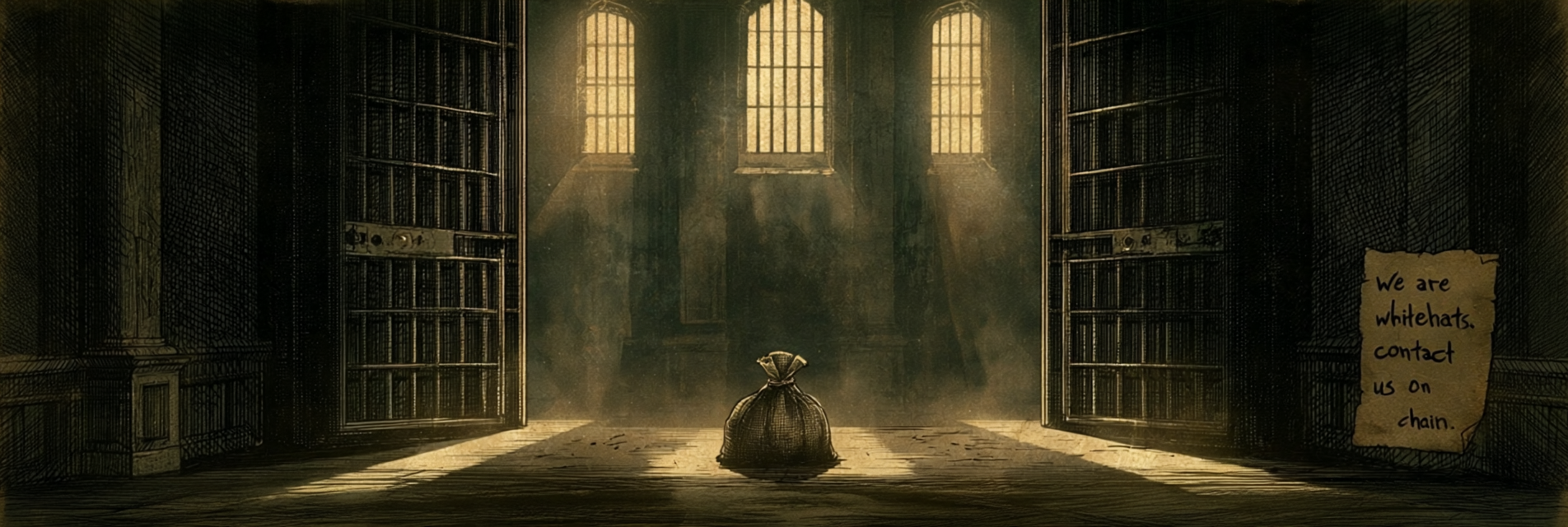
The negotiation itself was pure comedy. First an OP_RETURN transaction announced attackers as the "good guys":
we are whitehats, contact us on chain
Then the attackers scolded Liquid for being too slow to patch:
Please fix the bug first. The chain is under risk at latest commit right now. Make sure every node is patched. Then we will transfer the money back safely after confirming the fix.
The irony is that the attackers ran coordinated disclosure on Liquid's behalf complete with patch management and deployment verification.
Now the tragedy part is the one I wrote about in The Breaking Point of Ethical Security Research. A responsible security researcher who found this bug in August and mailed security@blockstream.com would have received a thank you note and maybe a credit somewhere in the release notes. The people who took the chain hostage just needed 48 hours to negotiate the largest ever "bug bounty". No ghosting, no dupes, no escalations, no mediation, none of the usual nonsense. Another slap in the face to every SR choosing to stay on the right side of the law.
Unfortunately Liquid Network was just one of four blockchains exploited this week. I've included detailed post-mortems and attack vectors for all 14 incidents this week including multi-million reward manipulation, function parameter validation, integer overflow and other hacks. The research section has the latest for both aspiring and professional bug hunters such as EVM fuzzer benchmarks, Solana audit tips, vulnerability write ups, and much more.
Let’s dive into the news!