
BlockThreat - May, 2026
Two attack vectors drove the biggest losses. The next major exploit may not start with a stolen key.


May 2026 saw $81M lost across 60 DeFi incidents. At first glance, that looks like an improvement from bloody April’s $644M in losses. Unfortunately, if we separate out the two major nation-state hacks, LayerZero/KelpDAO and Drift Protocol, the broader trend does not look better. So let’s not let relax just yet.
Monthly incident count remains elevated and the top losses are concentrated around just two attack vectors teams must prioritize. We will also fact-check the current state of operational security using BlockThreat's incident dataset to see whether the ecosystem really did get worse last month.
Let’s dive into the stats!

Bring BlockThreat Inside Your Security Program
See the threats that matter to your stack before they become your incident.
BlockThreat Enterprise gives security teams organization-specific threat intelligence reports, monthly briefings, priority access, and optional tailored feeds based on the exploits, threat actors, techniques, and trends I track every day across Web3.
Trusted by teams behind major L1s, DeFi protocols, staking infrastructure, wallets, and security organizations responsible for billions of dollars in assets.
Use BlockThreat Enterprise to see around corners, understand what is coming for your stack, and prepare your team before emerging risks turn into active exploits.
Subscribe to BlockThreat Enterprise - $2,000/month
Limited availability: Enterprise subscriptions include direct engagement and tailored reporting, so only a small number of teams can be supported.
May 2026 Incident Statistics
Total Incidents: 60 (-2%)
Total Loss: $81,414,933 (-87%)
Average Loss per Incident: $1,356,916 (-87%)
Total Recovered: $12,004,700 (-87%)
Top 5 DeFi Incidents
- Superfortune AI Compromise (Stolen Private Keys) - $15,180,000
- Verus Bridge Compromise (Signature Verification) - $11,580,000
- ThorChain Compromise 7 (Signature Verification) - $10,700,000
- DxSale Compromise (Stolen Private Keys) - $7,300,000
- Trusted Volumes Compromise (Signature Replay) - $6,700,000
Top 10 DeFi Attack Vectors
- Stolen Private Keys - 11 (+57%) - $28,184,170 (+49%)
- Signature Verification - 8 (+300%) - $25,914,700 (+582%)
- Function Parameter Validation - 4 (+100%) - $7,655,965 (+3854%)
- Arbitrary External Calls - 3 (-50%) - $3,412,700 (+35%)
- Insufficient Function Access Control - 7 (+75%) - $1,059,200 (+49%)
- Signature Replay - 1 (0%) - $6,700,000 (+4408%)
- Price Oracle Manipulation - 10 (+150%) - $561,650 (-97%)
- Function Parameter Injection - 1 (New) - $5,400,000 (New)
- Prompt Injection - 2 (New) - $593,750 (New)
- Reward Manipulation - 5 (-44%) - $212,000 (-96%)
Trends and Analysis
The broader ecosystem is still dealing with elevated exploit volume, but the top five incidents point to just two attack vectors:
Trend 1: Signature Verification Exploitation
The most concerning pattern in May was the surge in signature verification failures. Below is the list of related incidents from the past month:
2026/05/07 - Trusted Volumes ($6.7M) - No signer validation
2026/05/15 - ThorChain ($10.7M) - GG20 signature scheme 0day
2026/05/17 - Hermes Vault ($30K) - Faulty guard in the verifier LogicSig
2026/05/17 - Verus Bridge ($11.5M) - Bridge signature validation
2026/05/19 - RetoSwap ($270K) - No sender key verification
2026/05/20 - Map Protocol Bridge ($180K) - Forged bridge messages
2026/05/21 - Mure ($11K) - Does not validate trusted signer
2026/05/31 - MoneyMon ($85K) - Does not validate ecrecover
That is 8 incidents and roughly $30M stolen in a single month from the same broad attack class. The most affected category was cross-chain infrastructure, especially bridges, where signatures, attestations, relayers, and off-chain authority become part of the protocol’s core trust model.
To put this in perspective, May alone had almost as many signature verification exploits as the past five years combined:
2025 - 1
2024 - 2
2023 - 2
2022 - 4
2021 - 2
The sharp increase may be driven by better tooling, more attention from attackers, or simply the difficulty of implementing signature verification correctly across complex systems. Whatever the reason, this class should now be treated as a top audit and defense priority. That includes signer validation, domain separation, replay protection, signature malleability, message binding, chain ID binding, finality assumptions, and every place where an off-chain signature becomes on-chain authority.
Trend 2: Operational Security Failures
Only about 18% of May incidents and 34% of total stolen assets stemmed from operational security failures such as stolen private keys or infrastructure compromises:
05/03/2026 - Chaos Labs (Attempted) - Oracle operational wallets
05/18/2026 - Galxe ($220K) - Stolen signer key
05/18/2026 - Echo Protocol ($867K) - Single admin key compromise
05/22/2026 - Polymarket ($700K) - Old wallet compromise
05/23/2026 - StablIR ($2.8M) - Minting key compromise
05/27/2026 - StakeDAO ($91K) - Deployer key compromise
05/27/2026 - Fluid ($200K) - Monitoring dashboard compromise
05/30/2026 - Artificial Financial Intelligence ($480K)
To better gauge the current state of operation security, let's track trends this year including all operation security attack vectors including private key theft, multisig hijacking, internal and cloud infrastructure compromises, and others:
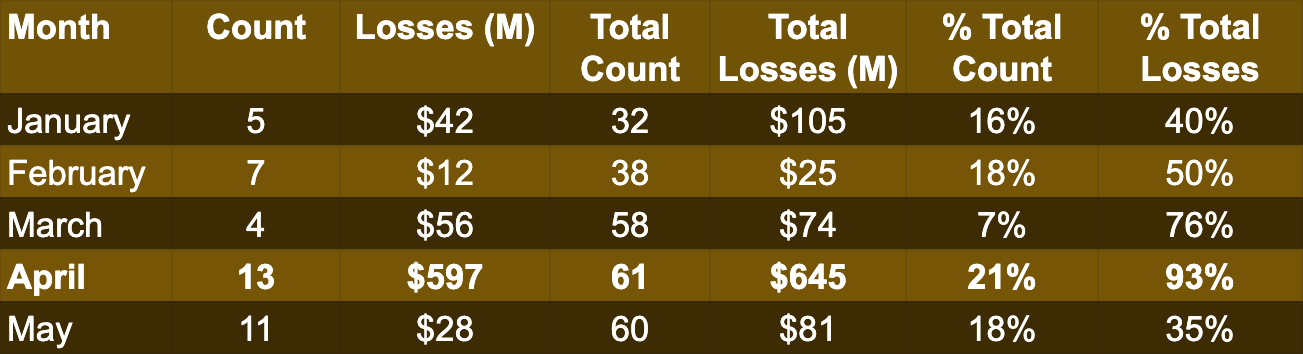
April certainly stands out as a brutal month with LayerZero and Drift Protocol exploits alone resulting in $577M losses. However overall the DeFi ecosystem is relatively stable and even trending down in the past month if we zoom out to look at the rest of the year.
Let's hope the trend continues in the future.
Future Outlook
The vast majority of DeFi incidents and losses in May came from smart contract and protocol exploitation rather than operational security failures. This suggests that while key management, phishing resistance, and infrastructure hardening remain critical, the next major losses are increasingly likely to come from vulnerable protocols and smart contracts rather than private key theft alone. Teams should continue improving operational security, but the near-term priority is deeper focus on code security related threats such as the signature verification attack vector above.